REVIEW · KUALA LUMPUR
Kuala Lumpur Cultural and Heritage Tour
Book on Viator →Operated by MALAYSIAN TOURS RIYAS · Bookable on Viator
One afternoon, six faith landmarks in Kuala Lumpur. This tour is a fast, practical way to see the city’s Hindu, Buddhist, Taoist, and Muslim heritage without wrestling with routes. I like that you get door-to-door hotel transfers in an air-conditioned vehicle, and that most stops have free admission tickets, so your money goes toward time—not entrance fees.
The main thing to weigh is simple: there’s an English-speaking driver, but no tour guide. So if you want deep, on-the-spot history and explanations, you’ll need to do a little self-guided reading before you go (or bring your own questions).
In This Review
- Key things to know before you book
- Price and value: $19.99 for a multi-site heritage hit
- Getting oriented: what this tour is really good for
- First stop: Chan See Shu Yuen Temple and its ceremonial detail
- Thean Hou Temple: a modern structure wearing tradition
- Sin Sze Si Ya Temple: Taoist worship and 1864 roots
- Jamek Mosque at the Klang and Gombak confluence
- Sri Maha Mariamman Temple: the 22-metre gate and incense air
- Sultan Abdul Samad Building and the Moorish look by Dataran Merdeka
- How the short 20-minute stops really feel
- What’s included (and what’s not) for your day
- Who should book this Kuala Lumpur Cultural and Heritage Tour?
- Should you book this tour?
- FAQ
- How long is the Kuala Lumpur Cultural and Heritage Tour?
- What’s the price per person?
- Do I get hotel pickup and drop-off?
- Is there a tour guide on this experience?
- Are admissions included for the temple and mosque stops?
- What stops are included in the tour?
- What language support is provided during the tour?
- Is food included in the price?
- Can I cancel for free?
Key things to know before you book
- Hotel pickup and drop-off mean less stress and less time figuring out transport in central Kuala Lumpur
- Free entry at each stop keeps the cost down and makes the route feel like real value
- Six major religious sites cover Buddhism, Taoism, Hinduism, and Islam in one compact circuit
- Short visits (about 20 minutes each) are ideal for seeing highlights, not lingering
- Driver-led navigation, no guide is great for efficiency, less ideal for story-heavy sightseeing
- Moorish architecture shows up twice in places tied to Kuala Lumpur’s early 1900s identity
Price and value: $19.99 for a multi-site heritage hit
At $19.99 per person for a 3-hour cultural and heritage loop, this is priced like an efficient sampler. The big reason it feels like a deal is that you’re not paying entrance fees for the main attractions—each stop lists free admission. That matters because Kuala Lumpur heritage sites can add up fast when multiple tickets are involved.
You also get air-conditioned vehicle transport plus hotel pickup & drop-off, which is a hidden cost saver. In a city where traffic can be unpredictable, door-to-door pickup keeps the experience straightforward and reduces the risk of showing up late.
One caution: because there’s no tour guide, you’re paying mostly for logistics. If you want someone to narrate each site in detail, this may feel more like a guided route than a guided experience.
You can also read our reviews of more historical tours in Kuala Lumpur
Getting oriented: what this tour is really good for
This is a tour for people who want to get their bearings fast. The route moves through some of Kuala Lumpur’s most recognizable heritage landmarks, especially those that reflect older communities and older worship traditions. You’ll see architectural styles that don’t look related at first glance, but you’ll start noticing the shared theme: how different cultures helped shape the city.
I like that the stops are diverse but not random. You get a deliberate mix: Buddhist clan temple, Taoist temple, a major mosque, a classic Hindu temple, and then the colonial-era Moorish look at Dataran Merdeka. It’s the kind of lineup that helps first-timers understand Kuala Lumpur as a place built by many communities.
If you’re the type who enjoys walking through sacred spaces respectfully and then reading signage at your own pace, you’ll likely do well here. If you’re hoping for a storyteller to connect every symbol, you’ll want to plan for self-study.
First stop: Chan See Shu Yuen Temple and its ceremonial detail
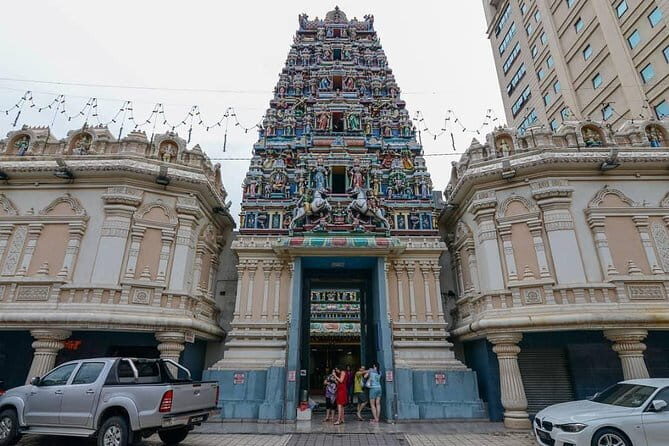
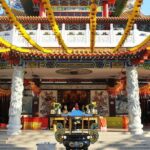
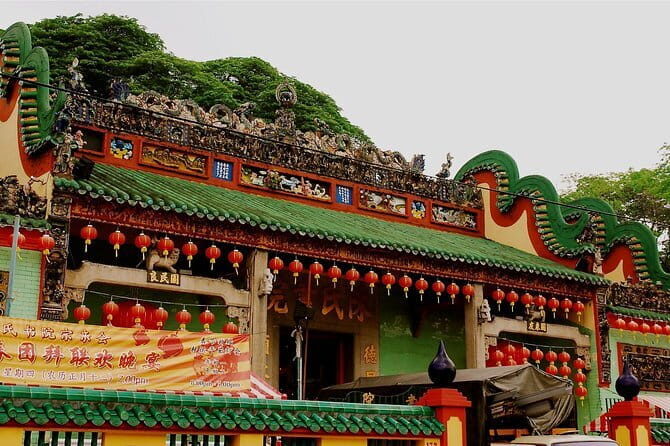
Your morning (or afternoon) starts at Chan See Shu Yuen Temple, one of Malaysia’s oldest and largest Buddhist temples. It was built between 1897 and 1906, and the structure shows it. The layout uses symmetrically arranged pavilions, with brightly colored paintings and wooden bas-reliefs that add a sense of layered artistry.
The roof is where your eyes will keep landing. The temple’s ceramic tile work includes wavy gables and decorative friezes in ceramic green and blue, shaped into mythological scenes. Even the corners are decorated with blue ceramic vases, so you get details on multiple visual levels—not just one main photo spot.
At the entrance, you’ll also notice the guardian figures: a man and a woman. The temple is tied to a clan association (Chan, Chen, Tan), which shows up in the way the temple’s meaning is framed. The central altar includes statues of the three founders, so even if you don’t read everything, you’ll see that this place is organized around community memory.
Tip for your 20 minutes: look up first (roof and tiles), then scan the bas-reliefs. It’s the fastest way to feel like you actually “saw” the place, not just walked through it.
Thean Hou Temple: a modern structure wearing tradition
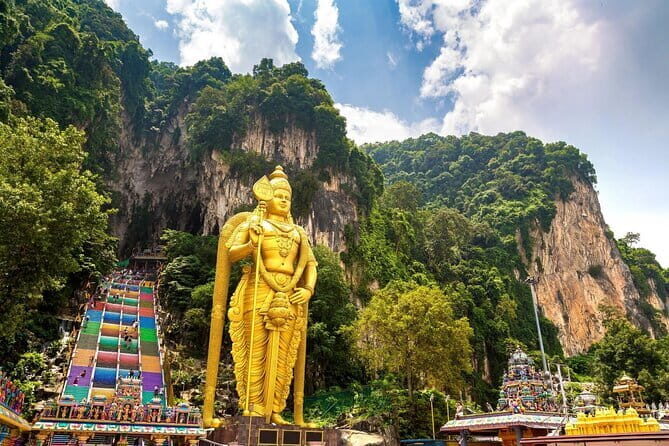
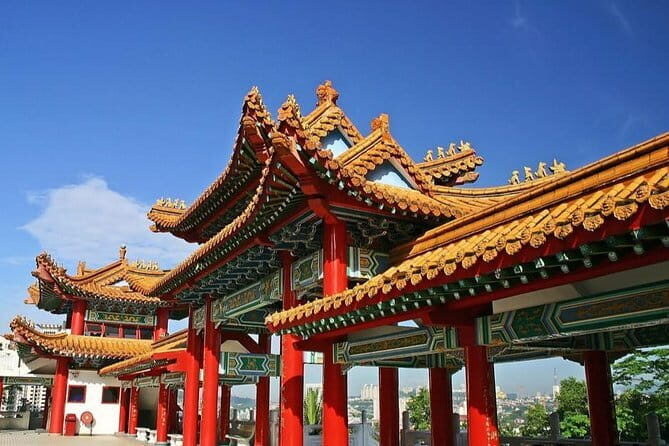
Next comes Thean Hou Temple, built much later than the first stop, between 1981 and 1987. Up close, you can tell it’s a modern structure underneath the ornate facade. Still, the overall effect is impressive, and the scale gives you a sense of why this is a major landmark for worship and pilgrimage.
It sprawls across six tiers, which means you’ll likely be moving with a gentle upward flow. The temple is managed by Malaysia’s Hainanese community, descended from sea-faring fisher folk from Hainan, China. That background helps the architecture feel less like a decorative showpiece and more like an identity statement.
Possible drawback: because it’s newer, you may not feel the same “old-world age” as you do at sites dating back to the 1800s. But the tradeoff is that the complex still delivers strong visual structure and a big sense of place.
Tip: if you want photos, give yourself a moment to frame the tier lines. That tiered layout is the signature look.
Sin Sze Si Ya Temple: Taoist worship and 1864 roots
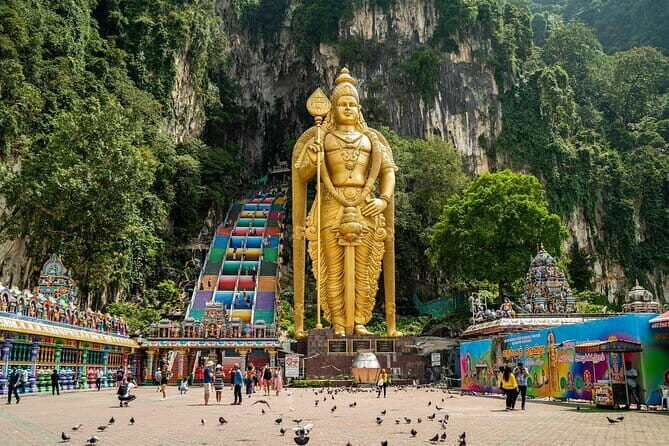
Then you’ll visit Sin Sze Si Ya Temple, noted as the oldest Taoist temple in Kuala Lumpur, with history dating back to 1864. Taoist temple design often rewards close attention, and this one leans into that with an ornate interior and elaborate roof ridges.
This temple is dedicated to deities of Sin Sze Ya and Si Sze Ya, so the focus is clearly religious rather than ceremonial-only. One detail that’s likely to catch your eye: it occupies an unusual position and angle. That means the visual experience can feel different from a “straight-on” temple you’re used to seeing from postcards.
With a short stop time, you won’t catch every nuance. But if you enjoy architecture and symbols—especially roofwork and interior ornamentation—you’ll probably feel satisfied even in a quick visit.
Tip: when you walk in, take five seconds to let your eyes adjust before you start hunting for photos. The interior design benefits from that moment of slow noticing.


Jamek Mosque at the Klang and Gombak confluence
Your route shifts to Islam with Jamek Mosque, officially the Sultan Abdul Samad Jamek Mosque. It sits at the confluence of the Klang and Gombak River, and that location helps explain why it became such a central early mosque. You can access it via Jalan Tun Perak.
Architecturally, the mosque uses Moorish design, and it was built in 1909. That Moorish influence is part of what makes it so recognizable on a city walk. It also has a deeper layer tied to place: it was built on the first Malay burial ground in the city.
Historically, it served as Kuala Lumpur’s main mosque before Masjid Negara opened in 1965. So when you’re standing there, you’re not only looking at architecture—you’re standing in a landmark that used to anchor religious life for the wider city.
Tip: bring a camera-ready mindset, but also slow down once. This is one stop where the meaning of the site is easier to feel when you pause.
Sri Maha Mariamman Temple: the 22-metre gate and incense air
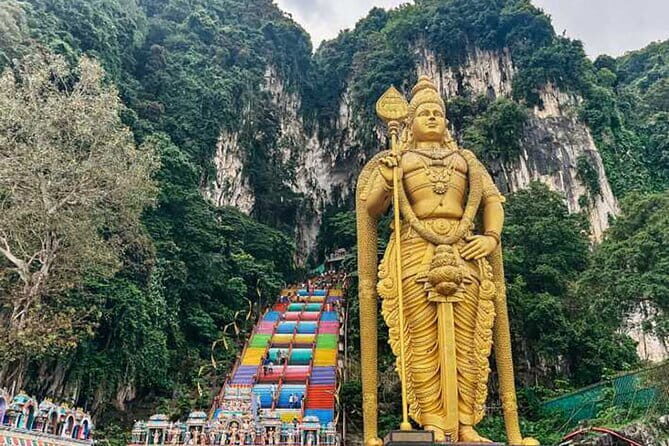
At Sri Maha Mariamman Temple, you’re in a Hindu setting shaped by older devotional traditions. The headline feature is the 22-metre-high gate tower and portico, covered with intricately carved images of Hindu deities. Even if you only glimpse it from the entrance approach, the scale reads instantly.
Inside, the temple honors the goddess Maha Mariamman, with details including gold and precious stones. This is also where sensory elements become part of the experience: you may see peddlers selling strings of jasmine garlands, and incense fills the air. That mix of ritual, craft, and everyday commerce around worship is part of why Hindu temples can feel so alive as cultural spaces.
Possible drawback: because there’s a lot happening around the entrance areas, you may want to mentally plan for crowds and distractions. Focus on the gate tower and the most visible carvings first, then spend the rest of your time looking inward.
Tip: if you’re sensitive to strong smells, take a slow breath before you enter the busiest zones. You can still enjoy the carvings and colors without rushing.
Sultan Abdul Samad Building and the Moorish look by Dataran Merdeka
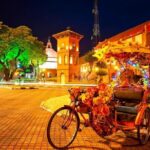
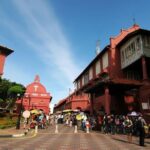
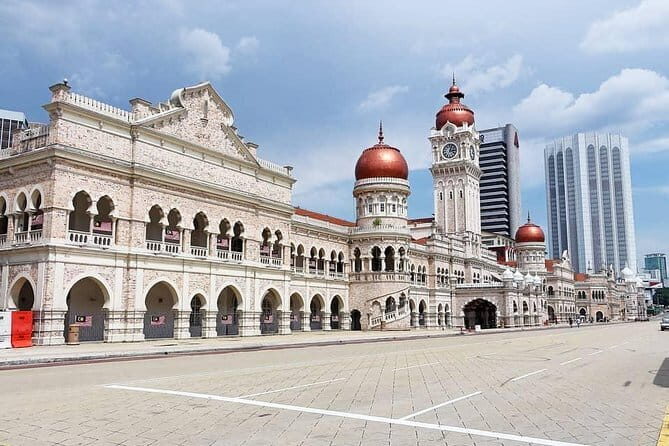
To close the route, you visit the Sultan Abdul Samad Building in front of Dataran Merdeka. This is one of the most photographed buildings in central Kuala Lumpur, and it makes sense why. It has distinctive Moorish designs and a clock tower, with a look that feels unmistakably tied to early British-era city styling.
The building houses the Supreme and High Courts, so it’s not just pretty architecture. It’s a working civic landmark, which gives the area a different energy than a temple or mosque stop. Seeing it right after religious heritage sites helps you understand how Kuala Lumpur’s identity layers changed over time—religious communities earlier on, and then government institutions in the colonial period.
Tip: take your photos of the clock tower and façade, then step back once to absorb the whole square. It helps you connect the building to Dataran Merdeka as a public space.
How the short 20-minute stops really feel
Each stop is listed at around 20 minutes, which is perfect if your goal is highlights and variety. You won’t be able to read every plaque or linger for long ceremonies, so treat each site like a focused visit: one or two key things to notice, then move on.
Because there’s no tour guide, the biggest difference between expectation and reality is narration. You’ll likely get directions and timing from the driver, but you’ll need to supply most of the interpretation yourself—through signage on-site and what you’ve read beforehand. For some people, that’s freeing. For others, it feels like a taxi ride between landmarks.
If you want to maximize value, do a quick prep step: choose one “must notice” item per stop (roof details, tier layout, roof ridges, river-side setting, gate tower, clock tower). That way, your time isn’t spent deciding what to look at once you arrive.
What’s included (and what’s not) for your day
You’re covered for transport and language support: air-conditioned vehicle, an English-speaking driver, and hotel pickup & drop-off. This makes the tour easier for you if you’re staying in central Kuala Lumpur and don’t want to piece together transit on your own.
What’s not included is also important: there’s no tour guide, and food and drinks aren’t included unless specified. So plan for water, especially since you’ll be outdoors walking between sites. If you’re sensitive to sun or heat, bring a hat and wear breathable clothing.
Most stops have free admission tickets, which is great for budgeting. Still, keep an eye out for any on-the-ground requirements for dress or behavior when you’re entering places of worship.
Who should book this Kuala Lumpur Cultural and Heritage Tour?
Book this if you:
- Want a short, structured route through major heritage landmarks
- Like seeing multiple faith sites in one afternoon without worrying about transport
- Prefer efficiency over long guided speeches
- Appreciate architecture and symbols more than detailed historical storytelling
Consider skipping or upgrading (if possible) if you:
- Want a guide to explain the meaning behind carvings, rituals, and major historical dates
- Prefer longer stays at each stop
- Need a more educational pace for religious sites
This tour fits well for first-time visitors who want to understand the city’s cultural mix and then explore longer on their own afterward.
Should you book this tour?
I think this is a good booking for you if you value logistics and variety over deep narration. The price feels fair because you’re getting air-conditioned pickup and drop-off, plus multiple free-entry sites packed into a tight 3-hour window.
But if you’re the kind of traveler who expects someone to connect every landmark to a clear story, plan to bring your own context. Either read a bit before you go or be ready to rely on what you see and the onsite information.
If you want a quick Kuala Lumpur heritage orientation that keeps your day efficient, this one is easy to recommend. If you want a guided lecture, you may leave wanting more.
FAQ
How long is the Kuala Lumpur Cultural and Heritage Tour?
It lasts about 3 hours.
What’s the price per person?
The price is $19.99 per person.
Do I get hotel pickup and drop-off?
Yes. The tour includes hotel pick-up and drop-off in an air-conditioned vehicle.
Is there a tour guide on this experience?
No. A tour guide is not included, and the driver navigates the route.
Are admissions included for the temple and mosque stops?
Yes. Each listed stop shows free admission tickets.
What stops are included in the tour?
The tour includes Chan See Shu Yuen Temple, Thean Hou Temple, Sin Sze Si Ya Temple, Jamek Mosque, Sri Maha Mariamman Temple, and the Sultan Abdul Samad Building.
What language support is provided during the tour?
The included driver speaks English.
Is food included in the price?
No. Food and drinks are not included unless specified.
Can I cancel for free?
Yes. You can cancel up to 24 hours in advance for a full refund. If you cancel less than 24 hours before the start time, it isn’t refunded.